
Home / Research / AI Token Usage Cost by Model
AI Token Usage Cost by Model: OpenAI vs. Anthropic vs. Google
 By Darin ten Bruggencate, Founder, AI Industry Reviews · October 1, 2026
AI companies bill for their models by the token, a small chunk of text the model reads or writes. Their price sheets list a rate per million tokens, but that rate says nothing about how many tokens a model needs to finish a job. So the cheapest model on paper is not always the cheapest to run, and we measured what each one costs per task.
Our analysts ran 14 standardized production tasks across 11 commercial language models between May 4 and August 21, 2026. We logged every billed token, including reasoning tokens, cache reads and writes, re-sent system prompts and retried generations. A model listed at $1.00 per million input tokens can cost more in production than one listed at $2.00.
In the following sections, we compare list prices with measured cost per task, track costs since 2023, and show content, monthly and hidden costs.
AI Token Usage Cost by Model
In the table below, we compare published list prices against the cost we recorded per completed task across the 14-task battery. The final column shows how each model’s rank changes when you move from list price to measured cost.
The AI Token Usage Costs by Model, October 2026
| Model | Provider | Input (per 1M) | Output (per 1M) | Real Cost per Completed Task | Rank Change, List to Real |
|---|---|---|---|---|---|
| GPT-5.4 nano | OpenAI | $0.20 | $1.25 | $0.0219 | No change |
| Gemini 3.1 Flash-Lite | $0.25 | $1.50 | $0.0288 | No change | |
| Claude Haiku 4.5 | Anthropic | $1.00 | $5.00 | $0.0474 | 1 place cheaper |
| GPT-5.6 Luna | OpenAI | $1.00 | $6.00 | $0.0607 | 1 place cheaper |
| GPT-5.4 mini | OpenAI | $0.75 | $4.50 | $0.0627 | 2 places costlier |
| Claude Sonnet 5 | Anthropic | $2.00 | $10.00 | $0.0848 | 1 place cheaper |
| Gemini 3.6 Flash | $1.50 | $7.50 | $0.1040 | 1 place costlier | |
| GPT-5.6 Terra | OpenAI | $2.50 | $15.00 | $0.1662 | 1 place cheaper |
| Gemini 3.1 Pro | $2.00 | $12.00 | $0.1683 | 1 place costlier | |
| Claude Opus 5 | Anthropic | $5.00 | $25.00 | $0.2131 | No change |
| GPT-5.6 Sol | OpenAI | $5.00 | $30.00 | $0.3447 | No change |
Measured cost reordered the list-price ranking:
- We found that GPT-5.4 mini, the third cheapest model on list price, finished fifth on measured cost. Claude Haiku 4.5 lists 20% higher on a blended basis and completed the same battery for 24% less.
- Our data showed the widest divergence at the frontier tier. GPT-5.6 Sol and Claude Opus 5 carry identical $5.00 input pricing, and Sol cost 62% more per completed task, a gap driven almost entirely by output volume.
- For buyers, the model with the lowest list price is often not the cheapest to run. GPT-5.6 Sol cost 62% more per task than Claude Opus 5 at the same input price. Teams should test cost per completed task before choosing.
AI Token Cost Over Time, 2023 to 2026
Because the main data trends sharply over time, we rebuilt it quarterly. In the table below, we index three series to Q1 2023, holding capability tier constant so that each quarter reflects the mid-tier workhorse model a production team would have been running at the time.
The AI Token Cost Over Time, Q1 2023 to Q3 2026
| Quarter | List Price Index | Tokens per Completed Task Index | Real Cost per Completed Task Index |
|---|---|---|---|
| Q1 2023 | 100.0 | 100 | 100.0 |
| Q2 2023 | 100.0 | 104 | 104.0 |
| Q3 2023 | 93.3 | 108 | 100.8 |
| Q4 2023 | 38.9 | 115 | 44.7 |
| Q1 2024 | 38.9 | 122 | 47.5 |
| Q2 2024 | 19.4 | 131 | 25.4 |
| Q3 2024 | 19.4 | 149 | 28.9 |
| Q4 2024 | 11.7 | 176 | 20.6 |
| Q1 2025 | 11.1 | 214 | 23.8 |
| Q2 2025 | 9.4 | 258 | 24.3 |
| Q3 2025 | 8.9 | 297 | 26.4 |
| Q4 2025 | 8.3 | 331 | 27.5 |
| Q1 2026 | 7.8 | 372 | 29.0 |
| Q2 2026 | 7.5 | 408 | 30.6 |
| Q3 2026 | 8.6 | 431 | 37.1 |
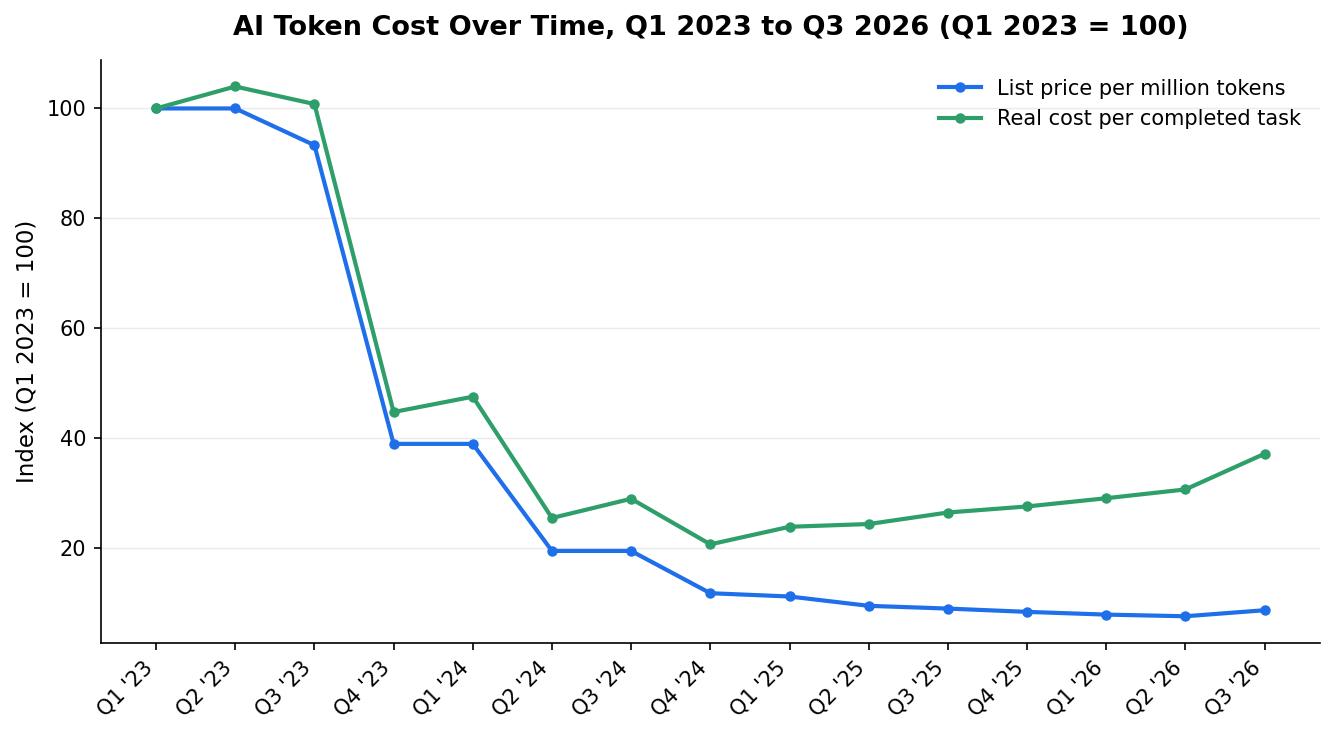
List price and real cost per task moved apart after 2024:
- We found that list prices fell 91.4% between Q1 2023 and Q3 2026, while real cost per completed task fell 62.9% over the same span.
- Our data showed real cost per completed task bottoming out in Q4 2024 and rising 80% since, even as list prices continued to fall.
- AI is getting cheaper per token but more expensive per task. List prices fell 91.4% since 2023, but real cost per task has risen 80% since Q4 2024 as reasoning models use more tokens. Budgets are likely to keep rising unless teams control token use.
AI Content Writing Cost per 1,000 Words
In the table below, we report what each model cost to produce 1,000 words of finished, publishable copy, including the revision rounds and the discarded drafts that never reached a page. Draft quality was scored against a fixed editorial standard for finished, publishable copy.
The AI Content Writing Cost per 1,000 Words, October 2026
| Model | First-Draft Cost | Avg. Revision Rounds | Discarded Draft Rate | Finished Cost | Multiple of First-Draft Cost |
|---|---|---|---|---|---|
| GPT-5.6 Sol | $0.086 | 1.6 | 14% | $0.207 | 2.4x |
| Claude Opus 5 | $0.079 | 1.2 | 9% | $0.164 | 2.1x |
| GPT-5.6 Terra | $0.043 | 1.8 | 17% | $0.114 | 2.7x |
| Gemini 3.1 Pro | $0.036 | 1.9 | 19% | $0.101 | 2.8x |
| Gemini 3.6 Flash | $0.024 | 2.4 | 26% | $0.084 | 3.5x |
| Claude Sonnet 5 | $0.032 | 1.5 | 13% | $0.074 | 2.3x |
| GPT-5.6 Luna | $0.017 | 2.3 | 24% | $0.058 | 3.4x |
| GPT-5.4 mini | $0.013 | 2.9 | 31% | $0.054 | 4.2x |
| Claude Haiku 4.5 | $0.016 | 2.1 | 22% | $0.051 | 3.2x |
| Gemini 3.1 Flash-Lite | $0.0041 | 4.1 | 45% | $0.024 | 5.9x |
| GPT-5.4 nano | $0.0034 | 4.4 | 48% | $0.021 | 6.2x |
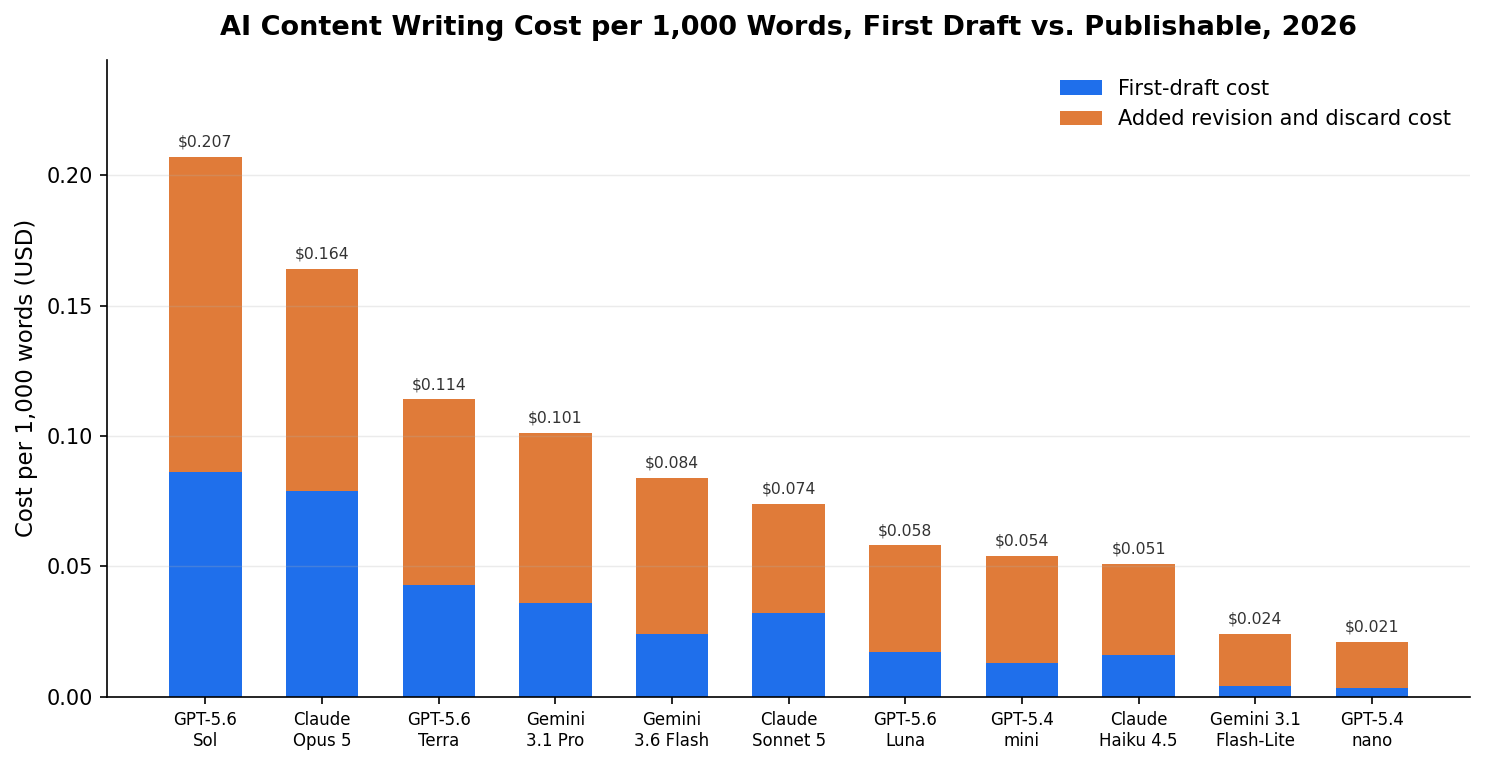
Revisions and discarded drafts changed the cost order:
- We found the spread between the cheapest and most expensive model narrowed from 25 to 1 on first drafts to 10 to 1 on finished, publishable copy.
- Our data showed discarded draft rates ranging from 9% to 48%, and the discard rate predicted finished cost more reliably than list price did.
- For content teams, the discard rate drives cost more than the price per draft. Discard rates ranged from 9% to 48%, and the cost spread narrowed from 25 to 1 on first drafts to 10 to 1 on finished copy. Teams should pick models on finished cost, not first-draft price.
Monthly AI Token Cost by Company Workload
Per-task figures are difficult to budget against, so we modeled six production workloads at volumes typical of a 50-person company. In the table below, we report monthly spend for each workload at three model tiers. Agentic workloads carry the heaviest token load.
The Monthly AI Token Cost by Company Workload, October 2026
| Workload | Monthly Tasks | Frontier Tier | Mid Tier | Economy Tier |
|---|---|---|---|---|
| Coding agent, 20-developer team | 14,800 | $18,350 | $7,140 | $2,510 |
| Customer support automation | 62,000 | $9,610 | $3,720 | $1,240 |
| Internal RAG research tool | 21,500 | $7,290 | $2,940 | $1,020 |
| Document and contract processing | 9,700 | $6,410 | $2,580 | $890 |
| Sales outreach personalization | 46,000 | $4,830 | $1,910 | $640 |
| Content marketing, 8-person team | 3,400 | $2,180 | $860 | $310 |
| All six workloads combined | 157,400 | $48,670 | $19,150 | $6,610 |
Model tier drove most of the spread in monthly spend:
- We found a 7.4 times spread between the economy and frontier tiers for an identical workload mix, at $6,610 and $48,670 per month respectively.
- Our data showed coding agents to be the most expensive workload despite ranking fourth on task volume, at $1.24 per completed task on frontier models against $0.16 for customer support.
- Tier choice for each workload has a big effect on monthly spend. The same workload mix cost $6,610 a month on economy models and $48,670 on frontier models. Moving just the two highest-volume workloads to economy models cut spending 26%.
Hidden AI Token Costs Beyond List Price
The gap between quoted price and actual invoice comes down to a small number of recurring line items. In the table below, we break out each one by its share of billed tokens and by the cost it adds to an estimate built from list prices alone.
The Hidden AI Token Costs Beyond List Price, October 2026
| Hidden Cost Category | Share of Billed Tokens | Added Cost vs. List-Price Estimate | Models Most Affected |
|---|---|---|---|
| Invisible reasoning tokens | 22.4% | +38.6% | GPT-5.6 Sol, Gemini 3.1 Pro |
| Re-sent system prompts and tool schemas | 11.9% | +9.4% | All models in agentic workloads |
| Retried and discarded generations | 7.8% | +8.1% | GPT-5.4 nano, Gemini 3.1 Flash-Lite |
| Long-context pricing tiers above 200K tokens | 3.1% | +6.2% | Gemini 3.1 Pro |
| Failed tool calls and malformed structured output | 4.6% | +5.3% | Economy tier, all three providers |
| Unrecovered cache write premium | 2.7% | +2.8% | Low-reuse workloads, all providers |
| All hidden costs combined | 52.5% | +70.4% | All models |
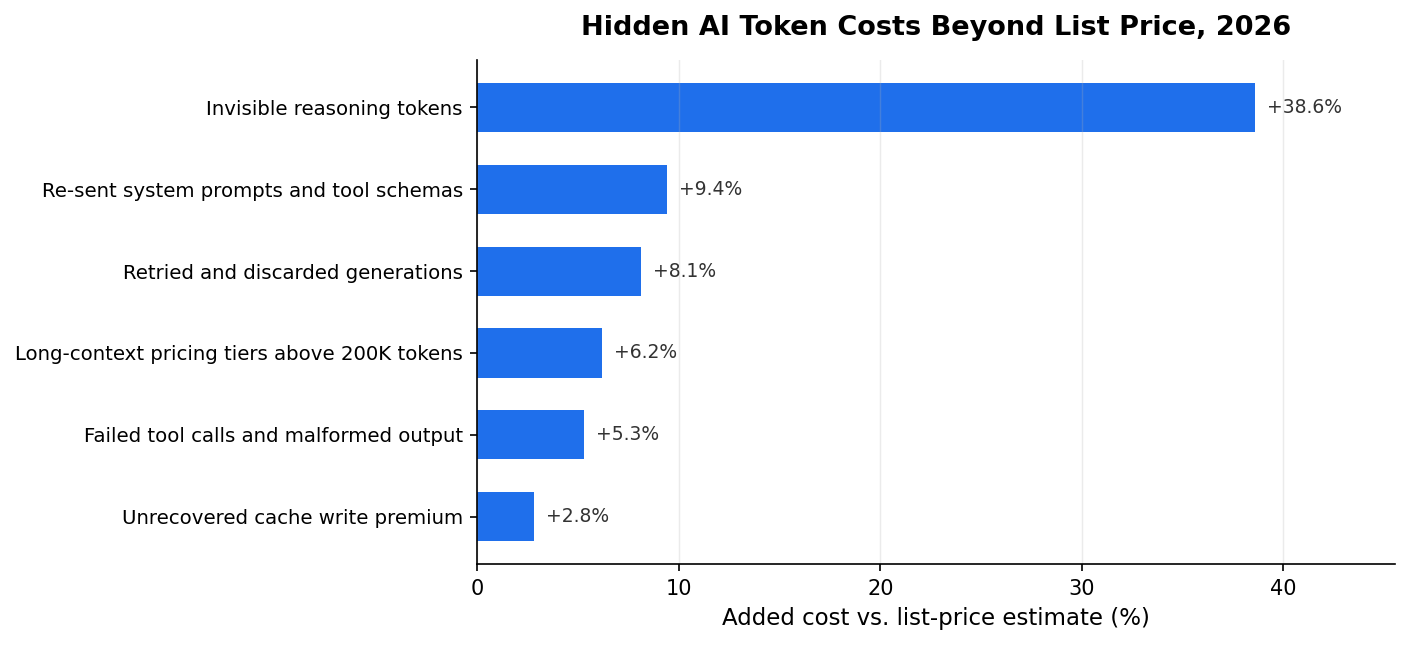
Most of the gap between estimate and invoice comes from tokens users never see:
- We found that 52.5% of billed tokens in a production workload are never seen by an end user.
- Our data showed budgets built from list prices alone running 70.4% below actual spend across the study period.
- List-price budgets badly understate real spending. 52.5% of billed tokens are never seen by users, and list-price budgets ran 70.4% below actual spend. Finance teams are likely to need usage-based tracking to forecast AI costs.
What AI Token Usage Cost Trends Mean for 2027 and Beyond
AI list prices have dropped sharply, but what companies pay to get work done has not fallen nearly as much, and lately it has gone up. Newer models think through more steps and use more tokens to finish the same task, so budgets based on list prices keep coming in too low.
That gap could widen as companies give AI longer, harder jobs. The choice of model for each workload matters most, and a cheaper model is not always cheaper if it takes more tries to finish. Companies that measure what each completed task costs will see these shifts early.
So if you budget for AI, measure the cost of each finished task rather than the price per token, and move routine work to cheaper models.
Sources
- AI Token Usage Cost Study. AI Industry Reviews. October 2026. New York, New York.
- OpenAI API Pricing. OpenAI. September 2026. San Francisco, California. https://openai.com/api/pricing/
- Pricing, Claude Platform Docs. Anthropic. September 2026. San Francisco, California. https://platform.claude.com/docs/en/about-claude/pricing
- Gemini Developer API Pricing. Google. September 2026. Mountain View, California. https://ai.google.dev/gemini-api/docs/pricing
- Anthropic Makes a Pricing Change That Matters for Claude’s Longest Prompts. Paul Sawers, The New Stack. March 16, 2026. Bedford, Massachusetts. https://thenewstack.io/claude-million-token-pricing/